
From Pit to Plant. Safe at Every Depth.
Haul road monitoring, blast perimeter enforcement, dust hazard detection, and fatigue risk assessment — across open-pit, underground, and processing operations.
Mining operations span vast areas with extreme hazard profiles — from haul road vehicle interactions to blast zone enforcement to dust and fatigue exposure. SAFVR's AURA engine provides unified safety intelligence across the entire mine-to-plant chain, detecting hazards in real time, automating safety workflows, training crews on site-specific protocols, and predicting where risk is accumulating across shifts.
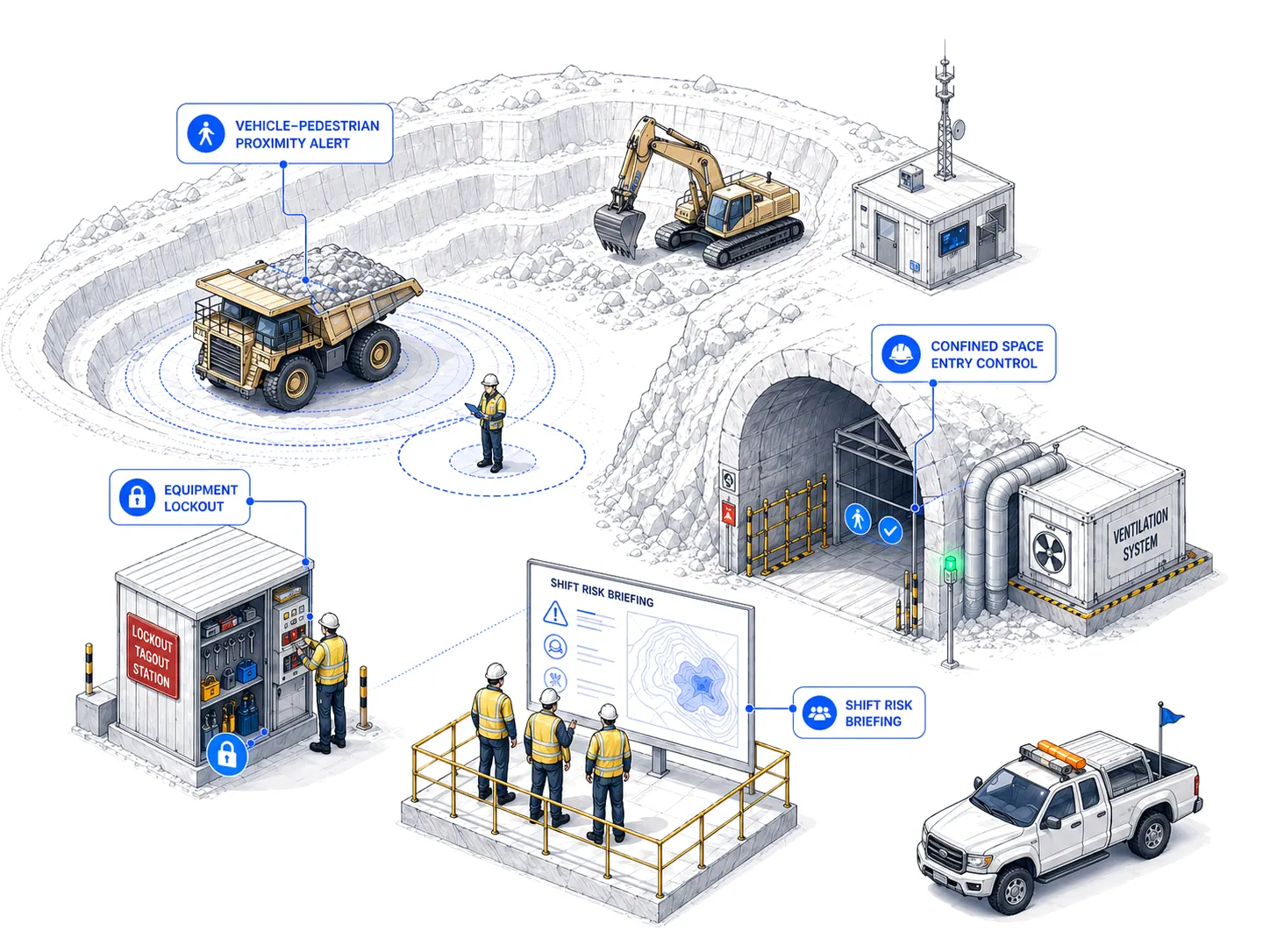
What Mining Safety Leaders Face Today.
- 01
Vast, Hostile Terrain
Open-pit and underground operations spanning kilometers, with vehicle-pedestrian interaction zones, elevation changes, and extreme environmental conditions that limit direct observation.
- 02
Vehicle-Pedestrian Fatality Risk
Haul trucks, excavators, and light vehicles interacting with ground crews across poorly defined traffic management zones — the leading cause of mining fatalities.
- 03
Fatigue & Environmental Exposure
Extended shifts, heat stress, dust exposure, and vibration fatigue compound gradually and invisibly until they manifest as incidents or health events.
Detect. Act. Improve. Prevent.
- 01 / DETECT
Mine-Wide Hazard Monitoring
Vision AI monitors haul road traffic management, blast perimeter enforcement, PPE compliance, and dust hazard indicators — across open-pit, underground, and processing areas.
Inside DETECT - 02 / ACT
Automated Safety Response
Real-time alerts to mine safety officers when vehicle-pedestrian proximity breaches, zone violations, or environmental thresholds are detected — with automated incident logging and escalation.
Inside ACT - 03 / IMPROVE
Crew-Specific Safety Training
Micro-training modules generated from your mine's own incident patterns and hazard profile — delivered to crews by role, zone, and shift, covering the exact risks they face.
Inside IMPROVE - 04 / PREVENT
Fatigue & Exposure Forecasting
AURA correlates shift duration, environmental conditions, near-miss frequency, and behavioral patterns to forecast fatigue-related and exposure-related risk across crews and zones.
Inside PREVENT
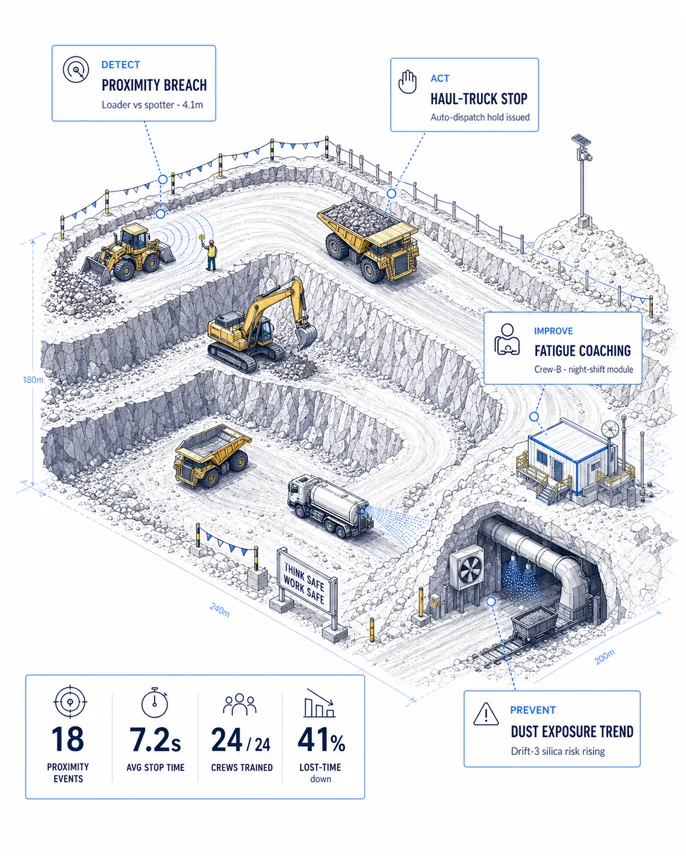
What Mining Pilots Measure.
Outcomes vary by camera coverage, baseline maturity, and workforce mix. Pilot results are measured per site over the 30-day deployment window.
Every System. Every Zone. One Platform.
Haul Road Monitoring
AURA tracks vehicle speed, following distance, and lane discipline across haul roads — detecting collision-risk patterns and routing alerts to dispatch before incidents occur on high-traffic corridors.
Vehicle-Pedestrian Safety
AI vision detects pedestrians in active vehicle zones — haul roads, loading areas, dump points — triggering instant alerts when separation distances breach site thresholds.
Blast Zone Compliance
AURA verifies blast perimeter clearance by tracking all personnel and vehicle positions against the defined exclusion boundary — confirming zone integrity before detonation authorisation.
Fatigue & Exposure Detection
Shift duration, environmental conditions (heat, dust, vibration), and near-miss frequency are correlated to surface fatigue and exposure risk — enabling proactive crew rotation before incidents develop.
Dust Hazard Monitoring
Vision AI monitors dust-generating operations for PPE compliance, ventilation effectiveness, and personnel exposure duration — surfacing trends by zone and shift to reduce silicosis and respiratory risk.
MSHA Compliance Automation
AURA auto-generates the recordkeeping and inspection evidence MSHA requires — incident classification, corrective-action tracking, and audit trails across surface and underground operations.
Common questions about SAFVR for mining.
- How does AURA reduce vehicle-pedestrian incidents on haul roads?
- AURA monitors haul road interaction zones in real time, flags proximity breaches between vehicles and ground crews, and routes alerts to dispatch and safety officers with positional evidence — directly attacking the leading cause of mining fatalities.
- Can AURA enforce blast perimeter compliance?
- Yes. Vision AI verifies perimeter clearance before blasts, detects unauthorized incursions, and logs evidence of compliance — providing audit-grade proof for every blast cycle.
- Does AURA work in underground mining environments?
- AURA supports both open-pit and underground operations with edge processing for low-bandwidth zones. Detection categories — PPE, vehicle proximity, restricted-area entry — apply equally to surface and underground deployments.
- How does AURA detect fatigue and environmental exposure risk?
- By correlating shift duration, environmental conditions (heat, dust, vibration), near-miss frequency, and behavioral patterns, AURA surfaces fatigue and exposure risk before incidents occur — enabling proactive crew rotation and intervention.
- Is AURA designed to support MSHA compliance?
- AURA is designed to support MSHA recordkeeping and inspection readiness with automated incident classification, corrective action tracking, and audit trail generation across surface and underground operations.
- Does SAFVR support underground mine safety monitoring?
- Yes. AURA is designed to support underground deployments using existing mine cameras with edge processing for low-bandwidth and intermittent-connectivity environments. Detection categories include PPE compliance, vehicle-pedestrian proximity, restricted-area entry, and ventilation-zone discipline.
Inside the Loop & Adjacent Industries.
See Every Metre of Your Operation
Start a paid 30-day pilot. AURA deploys across your mine site, monitors from pit to plant, and measures risk signals against your baseline.