Every Aisle. Every Shift. Every Risk.
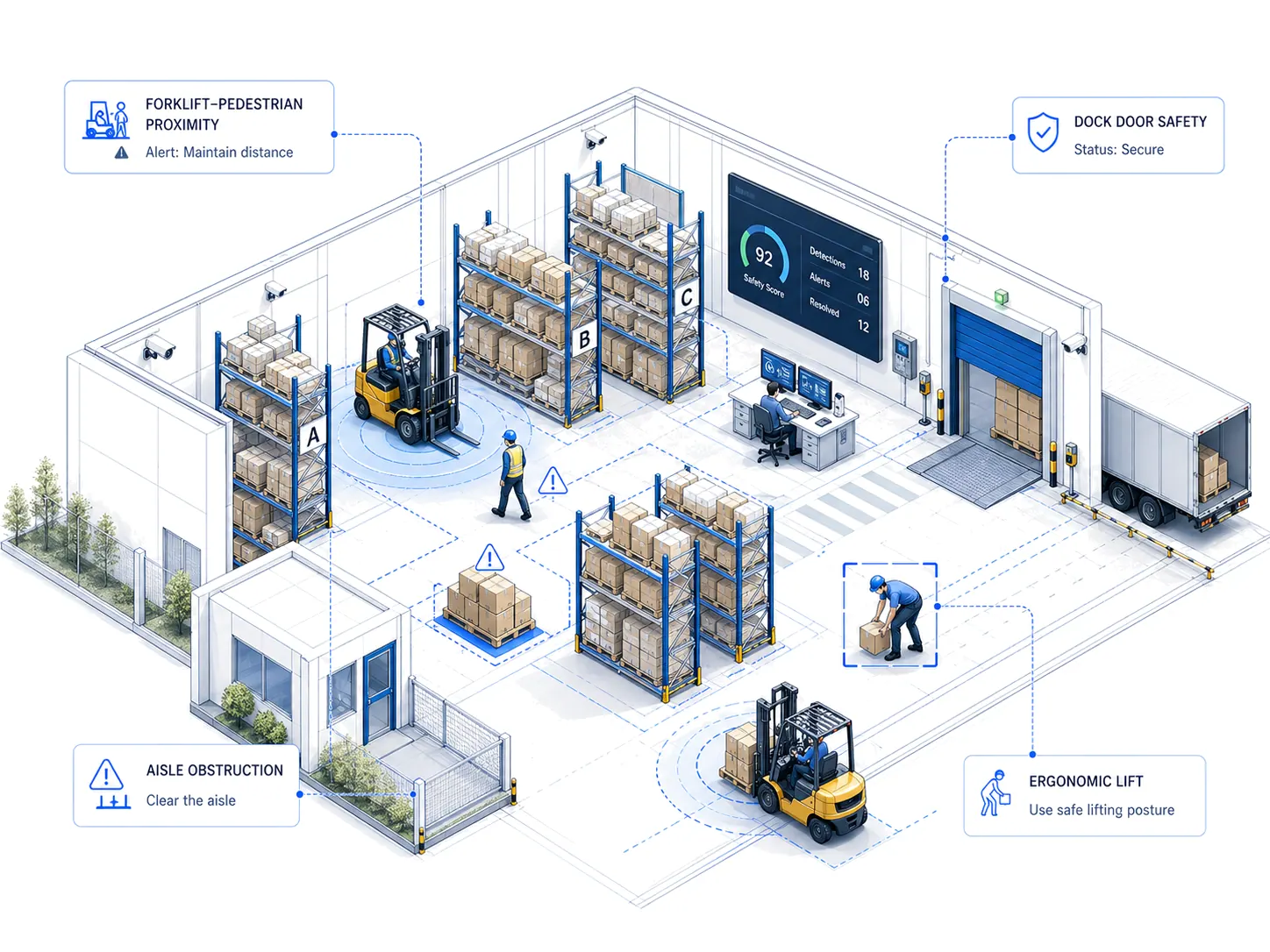
Dock-to-door monitoring, forklift-pedestrian proximity alerts, racking safety enforcement, and ergonomic assessment — across every shift, every season, every surge.
Warehousing and logistics operations move fast. High throughput, rotating workforces, and seasonal surges create compounding safety gaps. SAFVR's AURA engine monitors your entire operation from dock to dispatch — detecting risks in real time, automating safety workflows, training workers on the hazards specific to their zone, and predicting where the next incident is building.
What Warehousing Safety Leaders Face Today.
- 01
Speed Kills Visibility
High-throughput environments with constant movement between loading docks, aisle runs, and staging areas generate risks faster than floor supervisors can observe them.
- 02
Forklift-Pedestrian Collisions
Vehicle-pedestrian interaction zones at dock doors, cross-aisles, and staging areas remain the leading cause of severe warehouse injuries — invisible to static safety programs.
- 03
Seasonal Workforce Churn
Rapid onboarding for temporary workers during peak seasons. New hires are disproportionately represented in incident data because generic orientations don't cover site-specific risks.
Detect. Act. Improve. Prevent.
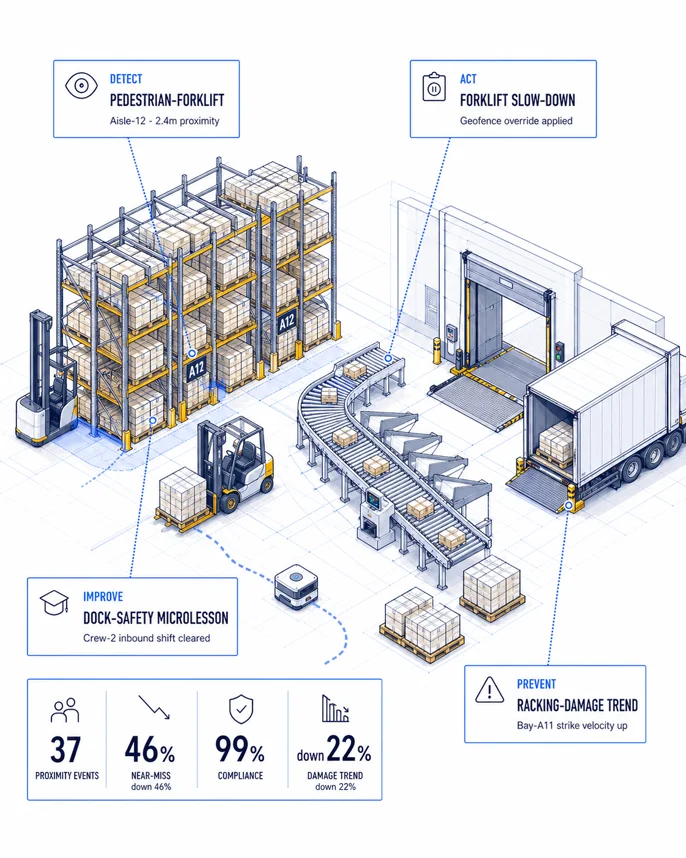
- 01 / DETECT
Dock-to-Door Hazard Monitoring
Vision AI monitors loading docks, forklift zones, pedestrian paths, racking areas, and ergonomic risk patterns — calibrated to your warehouse layout and traffic flows.
Inside DETECT - 02 / ACT
Instant Floor Manager Alerts
Real-time alerts to floor managers when zone violations, forklift-pedestrian proximity breaches, or near-misses are detected — with automated escalation and corrective action tracking.
Inside ACT - 03 / IMPROVE
Rapid Safety Onboarding
Site-specific visual micro-training for new hires and seasonal workers — covering the exact risks in their assigned zone, delivered on any device, in their language, under 5 minutes.
Inside IMPROVE - 04 / PREVENT
Seasonal Risk Forecasting
AURA tracks near-miss frequency, zone violation trends, and workforce experience levels across shifts — forecasting where incident risk peaks during seasonal surges before injuries happen.
Inside PREVENT
What Warehousing Pilots Measure.
Outcomes vary by camera coverage, baseline maturity, and workforce mix. Pilot results are measured per site over the 30-day deployment window.
Every System. Every Zone. One Platform.
Forklift Collision Avoidance
AURA detects obstacles in every forklift's travel path — pedestrians, racking, other vehicles — and triggers instant alerts before a collision occurs. Camera-based, so there's no sensor retrofit per vehicle.
Forklift Proximity Alerts
Real-time notifications fire the moment a forklift breaches a proximity threshold near a pedestrian or structure. AURA generates alerts from overhead camera feeds, covering every zone without hardware on individual forklifts.
Pedestrian Detection Zones
Digitally defined areas where AI vision monitors for unauthorized pedestrian presence near active vehicle routes, dock doors, or machinery. Every violation triggers an alert and feeds trend analysis.
Dock Safety Monitoring
Continuous AI surveillance of loading dock operations — tracking trailer positions, pedestrian intrusion during active loading, forklift speed near dock edges, and PPE compliance in high-traffic staging areas.
Ergonomic Risk Detection
Vision AI flags repetitive-motion patterns, awkward lifts, and posture risk across pick lines and packing stations — surfacing trends by zone, shift, and crew so EHS can intervene before strain becomes injury.
Seasonal Workforce Onboarding
AI generates site-specific micro-training from your facility's own incidents and zone hazards. Delivered in the worker's preferred language, on any device, in under 5 minutes per lesson — compressing days of orientation into hours.
Common questions about SAFVR for warehousing & logistics.
- How does AI prevent forklift-pedestrian collisions in warehouses?
- AURA tracks vehicle and pedestrian paths in real time across dock doors, cross-aisles, and staging areas. Proximity breaches trigger instant alerts to the floor manager and log evidence to the corrective-action workflow — turning the leading cause of severe warehouse injuries into a measurable, actionable signal.
- Does SAFVR work with our existing WMS and warehouse cameras?
- Yes. AURA runs on your existing IP/CCTV cameras and routes alerts to the channels your floor managers already use (Slack, Teams, SMS, email). Detection events and corrective-action records can be synced back to your WMS or EHS system of record.
- How fast can we onboard seasonal workers with site-specific training?
- Micro-training modules are generated from your facility's own incidents and zone hazards, delivered in the worker's preferred language on any device, in under 5 minutes per lesson. Seasonal onboarding cycles that took days compress into hours of relevant, role-specific learning.
- Can AURA detect ergonomic strain risks during high-throughput shifts?
- Vision AI flags repetitive-motion patterns, awkward lifts, and posture risk indicators across pick lines and packing stations. Trends are surfaced by zone, shift, and crew so EHS can intervene before strain becomes an injury.
- What kind of ROI do warehouses see in a 30-day pilot?
- Warehousing pilots typically report fewer near-misses, faster seasonal onboarding, and a measurable drop in zone violations within the first 30 days. Outcomes vary by camera coverage, workforce mix, and baseline incident rate; a pilot quantifies the impact on your sites.
- Does SAFVR detect forklift-pedestrian near misses?
- Yes. AURA uses existing warehouse cameras to track forklift and pedestrian paths in real time, flagging proximity breaches at intersections, dock doors, and cross-aisles. Each near-miss event is logged with positional evidence and routed to floor managers for immediate corrective action.
- What is a forklift collision avoidance system?
- A forklift collision avoidance system uses sensors, cameras, or AI vision to detect obstacles — pedestrians, racking, other vehicles — in a forklift's path and triggers automatic alerts or speed reduction. SAFVR's AURA engine delivers camera-based forklift collision avoidance without retrofitting vehicles, using your existing warehouse cameras to monitor every aisle and intersection.
- How do forklift warning systems work in warehouses?
- Forklift warning systems alert operators and pedestrians to proximity risks at blind corners, dock doors, and cross-aisles. Traditional systems use blue lights or beepers mounted on forklifts. SAFVR replaces hardware-per-vehicle approaches with AI vision — detecting all vehicles and pedestrians from overhead cameras and routing instant alerts to floor managers, operators, and dashboard displays.
- What forklift alert systems does SAFVR provide?
- SAFVR provides camera-based forklift alert systems that monitor vehicle-pedestrian proximity, speed violations, and path conflicts across your entire warehouse floor. Alerts route to floor managers via Slack, Teams, SMS, or email within seconds of detection — no sensors on vehicles, no infrastructure per forklift, just your existing IP cameras and AURA's vision AI.
- How does AI improve loading dock safety?
- AI monitors loading dock zones for pedestrian intrusion during active loading, trailer-drift detection, forklift speed violations near dock edges, and PPE compliance in high-traffic staging areas. SAFVR's dock safety monitoring runs on existing dock cameras and flags violations in real time — reducing the dock zone incidents that account for a disproportionate share of severe warehouse injuries.
Inside the Loop & Adjacent Industries.
See Every Aisle, Every Shift
Start a paid 30-day pilot. AURA deploys on your existing cameras and validates value before your next peak season.